 fss-code-server
c6541440bc
fss-code-server
c6541440bc
- Tested FSS-Mini-RAG with software development documentation
- Created intelligent knowledge base for domain queries
- Evaluated search effectiveness for professional workflows
- Documented no issues found - excellent performance
- Rating: 9/10 overall effectiveness
FSS-Mini-RAG 
A lightweight, educational RAG system that actually works
Built for beginners who want results, and developers who want to understand how RAG really works
🚀 Quick Start - Install in 30 Seconds
Linux/macOS (tested on Ubuntu 22.04, macOS 13+):
curl -fsSL https://raw.githubusercontent.com/fsscoding/fss-mini-rag/main/install.sh | bash
Windows (tested on Windows 10/11):
iwr https://raw.githubusercontent.com/fsscoding/fss-mini-rag/main/install.ps1 -UseBasicParsing | iex
Then immediately start using it:
# Create your first RAG index
rag-mini init

# Search your codebase
rag-mini search "authentication logic"
These installers automatically handle dependencies and provide helpful guidance if anything goes wrong.
Demo
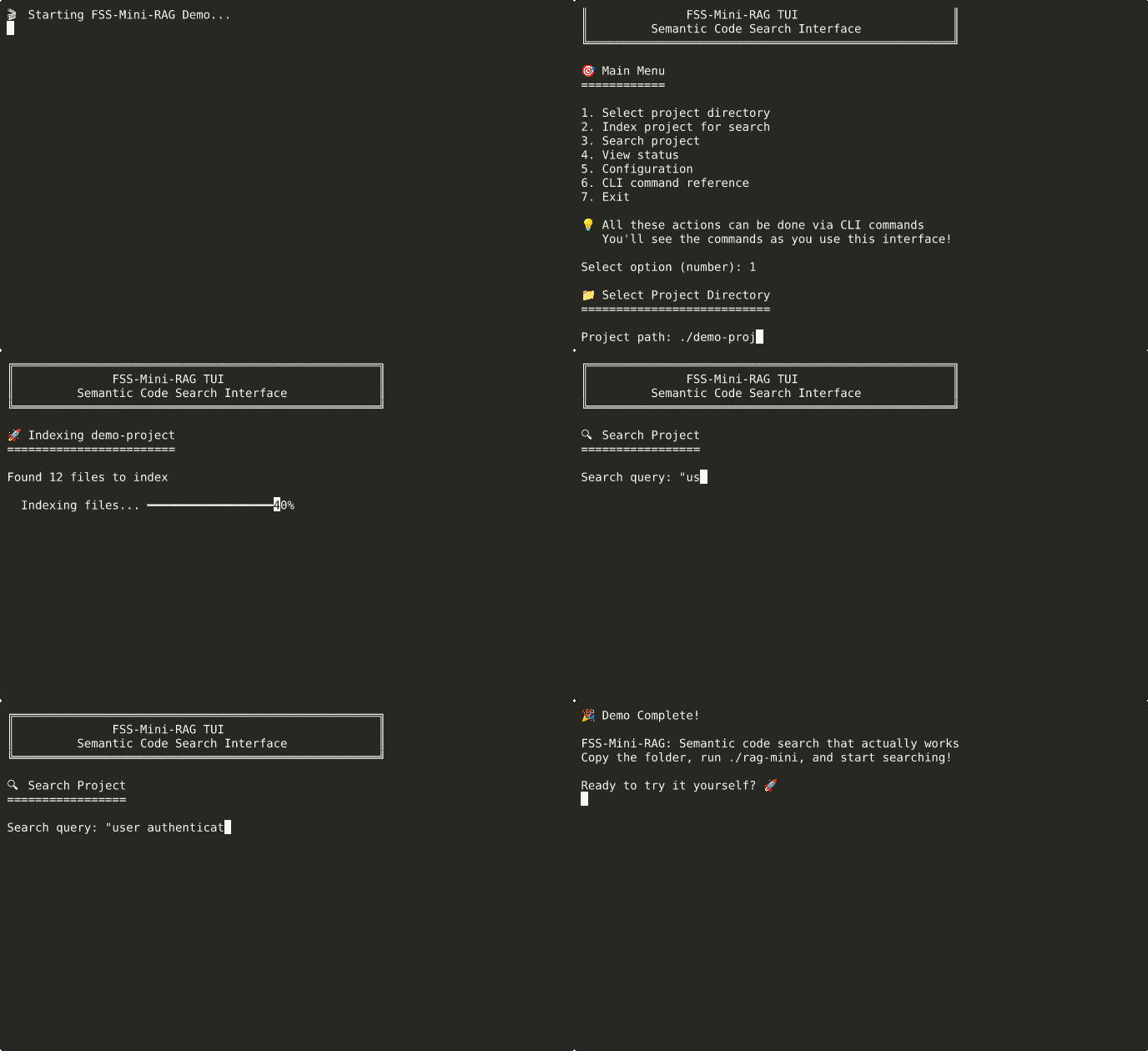
See it in action: index a project and search semantically in seconds
How It Works
flowchart TD
    Start([🚀 Start FSS-Mini-RAG]) --> Interface{Choose Interface}

    Interface -->|Beginners| TUI[🖥️ Interactive TUI<br/>./rag-tui]
    Interface -->|Power Users| CLI[⚡ Advanced CLI<br/>./rag-mini <command>]

    TUI --> SelectFolder[📁 Select Folder to Index]
    CLI --> SelectFolder

    SelectFolder --> Index[🔍 Index Documents<br/>Creates searchable database]

    Index --> Ready{📚 Ready to Search}

    Ready -->|Quick Answers| Search[🔍 Search Mode<br/>Fast semantic search]
    Ready -->|Deep Analysis| Explore[🧠 Explore Mode<br/>AI-powered analysis]

    Search --> SearchResults[📋 Instant Results<br/>Ranked by relevance]
    Explore --> ExploreResults[💬 AI Conversation<br/>Context + reasoning]

    SearchResults --> More{Want More?}
    ExploreResults --> More

    More -->|Different Query| Ready
    More -->|Advanced Features| CLI
    More -->|Done| End([✅ Success!])

    CLI -.->|Full Power| AdvancedFeatures[⚡ Advanced Features:<br/>• Batch processing<br/>• Custom parameters<br/>• Automation scripts<br/>• Background server]

    style Start fill:#e8f5e8,stroke:#4caf50,stroke-width:2px
    style CLI fill:#fff9c4,stroke:#f57c00,stroke-width:3px
    style AdvancedFeatures fill:#fff9c4,stroke:#f57c00,stroke-width:2px
    style Search fill:#e3f2fd,stroke:#2196f3,stroke-width:2px
    style Explore fill:#f3e5f5,stroke:#9c27b0,stroke-width:2px
    style End fill:#e8f5e8,stroke:#4caf50,stroke-width:2px
What This Is
FSS-Mini-RAG is a distilled, lightweight implementation of a production-quality RAG (Retrieval Augmented Generation) search system. Born from 2 years of building, refining, and tuning RAG systems - from enterprise-scale solutions handling 14,000 queries/second to lightweight implementations that anyone can install and understand.
The Problem This Solves: Most RAG implementations are either too simple (poor results) or too complex (impossible to understand and modify). This bridges that gap.
Two Powerful Modes
FSS-Mini-RAG offers two distinct experiences optimized for different use cases:
🚀 Synthesis Mode - Fast & Consistent
./rag-mini search ~/project "authentication logic" --synthesize
- Perfect for: Quick answers, code discovery, fast lookups
- Speed: Lightning fast responses (no thinking overhead)
- Quality: Consistent, reliable results
🧠 Exploration Mode - Deep & Interactive
./rag-mini explore ~/project
> How does authentication work in this codebase?
> Why is the login function slow?
> What security concerns should I be aware of?
- Perfect for: Learning codebases, debugging, detailed analysis
- Features: Thinking-enabled LLM, conversation memory, follow-up questions
- Quality: Deep reasoning with full context awareness
Quick Start (2-10 Minutes)
⏱️ Installation Time: Typical install takes 2-3 minutes with fast internet, up to 5-10 minutes on slower connections due to large dependencies (LanceDB 36MB, PyArrow 43MB, PyLance 44MB).
Step 1: Install
# Clone the repository
git clone https://github.com/FSSCoding/Fss-Mini-Rag.git
cd Fss-Mini-Rag

# Install dependencies and package
python3 -m venv .venv

# CRITICAL: Use full path activation for reliability
.venv/bin/python -m pip install -r requirements.txt  # 1-8 minutes (depends on connection)
.venv/bin/python -m pip install .                    # ~1 minute

# Activate environment for using the command
source .venv/bin/activate    # Linux/macOS
# .venv\Scripts\activate     # Windows
If you get "externally-managed-environment" error:
# Use direct path method (bypasses system restrictions entirely)
.venv/bin/python -m pip install -r requirements.txt --break-system-packages
.venv/bin/python -m pip install . --break-system-packages

# Then activate for using the command
source .venv/bin/activate
Step 2: Create an Index & Start Using
# Navigate to any project and create an index
cd ~/my-project
rag-mini init                # Create index for current directory
# OR: rag-mini init -p /path/to/project  (specify path)

# Now search your codebase
rag-mini search "authentication logic"
rag-mini search "how does login work"

# Or use the interactive interface (from installation directory)
./rag-tui                    # Interactive TUI interface
💡 Global Command: After installation,
rag-miniworks from anywhere. It includes intelligent path detection to find nearby indexes and guide you to the right location.
That's it. No external dependencies, no configuration required, no PhD in computer science needed.
What Makes This Different
For Beginners
- Just works - Zero configuration required
- Multiple interfaces - TUI for learning, CLI for speed
- Educational - Shows you CLI commands as you use the TUI
- Solid results - Finds code by meaning, not just keywords
For Developers
- Hackable - Clean, documented code you can actually modify
- Configurable - YAML config for everything, or change the code directly
- Multiple embedding options - Ollama, ML models, or hash-based
- Production patterns - Streaming, batching, error handling, monitoring
For Learning
- Complete technical documentation - How chunking, embedding, and search actually work
- Educational tests - See the system in action with real examples
- No magic - Every decision explained, every component documented
Usage Examples
Find Code by Concept
./rag-mini search ~/project "user authentication"
# Finds: login functions, auth middleware, session handling, password validation
Natural Language Queries
./rag-mini search ~/project "error handling for database connections"
# Finds: try/catch blocks, connection pool error handlers, retry logic
Development Workflow
./rag-mini index ~/new-project              # Index once
./rag-mini search ~/new-project "API endpoints"   # Search as needed
./rag-mini status ~/new-project            # Check index health
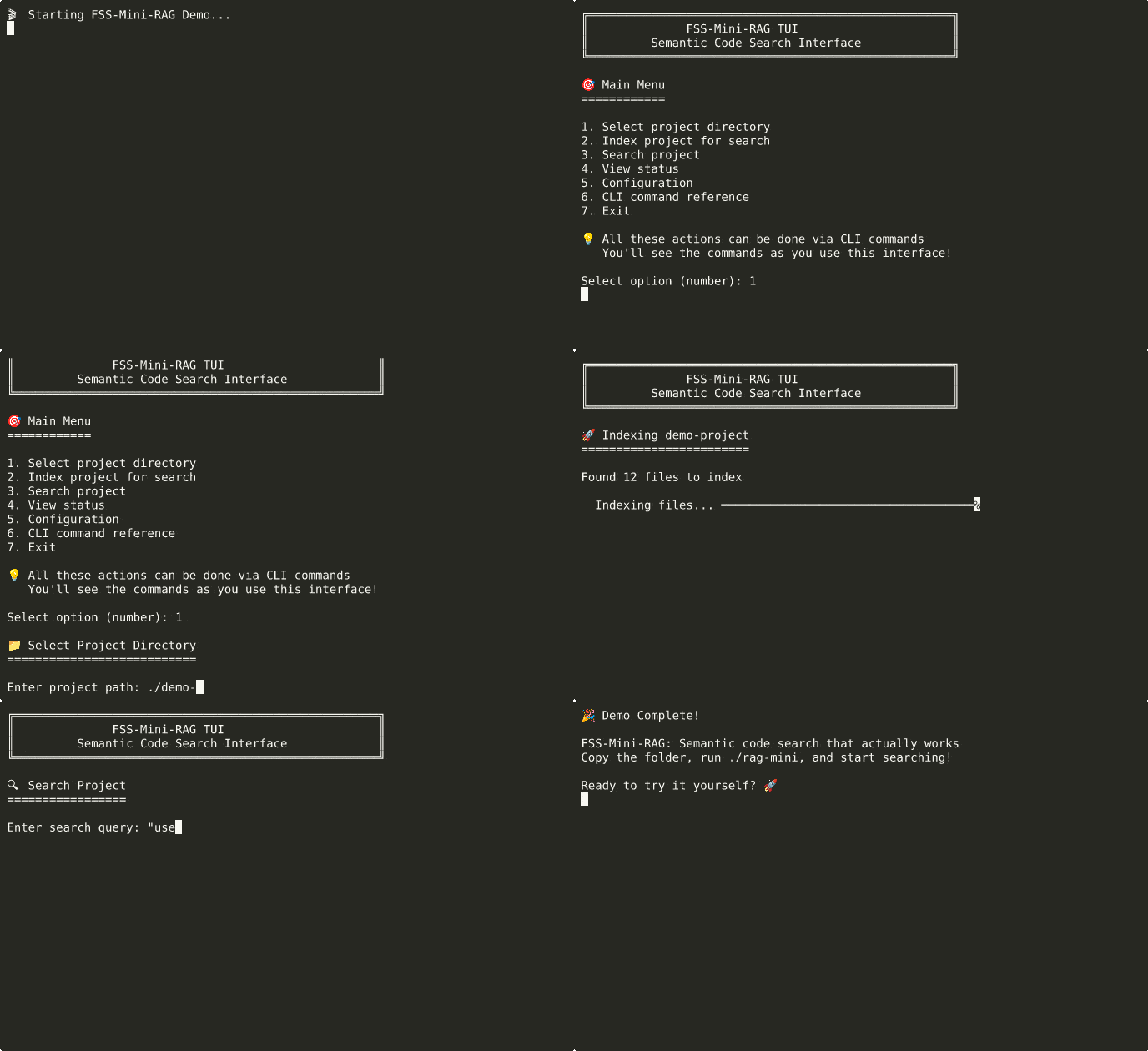
Advanced usage: semantic search with synthesis and exploration modes
Installation Options
🚀 One-Line Installers (Recommended)
The easiest way to install FSS-Mini-RAG - these scripts automatically handle uv, pipx, or pip:
Linux/macOS:
curl -fsSL https://raw.githubusercontent.com/fsscoding/fss-mini-rag/main/install.sh | bash
Windows PowerShell:
iwr https://raw.githubusercontent.com/fsscoding/fss-mini-rag/main/install.ps1 -UseBasicParsing | iex
These scripts install uv (fast package manager) when possible, fall back to pipx, then pip. No Python knowledge required!
📦 Manual Installation Methods
With uv (fastest, ~2-3 seconds):
# Install uv if you don't have it
curl -LsSf https://astral.sh/uv/install.sh | sh
# Install FSS-Mini-RAG
uv tool install fss-mini-rag
With pipx (clean, isolated):
# pipx keeps tools isolated from your system Python
pipx install fss-mini-rag
With pip (classic):
pip install --user fss-mini-rag
Single file (no Python knowledge needed):
Download the latest rag-mini.pyz from releases and run:
python rag-mini.pyz --help
python rag-mini.pyz init
python rag-mini.pyz search "your query"
🎯 Development Installation (From Source)
Perfect for contributors or if you want the latest features:
Fresh Ubuntu/Debian System:
# Install required system packages
sudo apt update && sudo apt install -y python3 python3-pip python3-venv git curl

# Clone and setup FSS-Mini-RAG
git clone https://github.com/FSSCoding/Fss-Mini-Rag.git
cd Fss-Mini-Rag

# Create isolated Python environment
python3 -m venv .venv
source .venv/bin/activate

# Install Python dependencies
pip install -r requirements.txt

# Optional: Install Ollama for best search quality (secure method)
curl -fsSL https://ollama.com/install.sh -o /tmp/ollama-install.sh
# Verify it's a shell script (basic safety check)
file /tmp/ollama-install.sh | grep -q "shell script" && chmod +x /tmp/ollama-install.sh && /tmp/ollama-install.sh
rm -f /tmp/ollama-install.sh
ollama serve &
sleep 3
ollama pull nomic-embed-text

# Ready to use!
./rag-mini index /path/to/your/project
./rag-mini search /path/to/your/project "your search query"
Fresh CentOS/RHEL/Fedora System:
# Install required system packages
sudo dnf install -y python3 python3-pip python3-venv git curl

# Clone and setup FSS-Mini-RAG
git clone https://github.com/FSSCoding/Fss-Mini-Rag.git
cd Fss-Mini-Rag

# Create isolated Python environment
python3 -m venv .venv
source .venv/bin/activate

# Install Python dependencies
pip install -r requirements.txt

# Optional: Install Ollama for best search quality (secure method)
curl -fsSL https://ollama.com/install.sh -o /tmp/ollama-install.sh
# Verify it's a shell script (basic safety check)
file /tmp/ollama-install.sh | grep -q "shell script" && chmod +x /tmp/ollama-install.sh && /tmp/ollama-install.sh
rm -f /tmp/ollama-install.sh
ollama serve &
sleep 3
ollama pull nomic-embed-text

# Ready to use!
./rag-mini index /path/to/your/project
./rag-mini search /path/to/your/project "your search query"
Fresh macOS System:
# Install Homebrew (if not installed)
/bin/bash -c "$(curl -fsSL https://raw.githubusercontent.com/Homebrew/install/HEAD/install.sh)"

# Install required packages
brew install python3 git curl

# Clone and setup FSS-Mini-RAG
git clone https://github.com/FSSCoding/Fss-Mini-Rag.git
cd Fss-Mini-Rag

# Create isolated Python environment
python3 -m venv .venv
source .venv/bin/activate

# Install Python dependencies
pip install -r requirements.txt

# Optional: Install Ollama for best search quality (secure method)
curl -fsSL https://ollama.com/install.sh -o /tmp/ollama-install.sh
# Verify it's a shell script (basic safety check)
file /tmp/ollama-install.sh | grep -q "shell script" && chmod +x /tmp/ollama-install.sh && /tmp/ollama-install.sh
rm -f /tmp/ollama-install.sh
ollama serve &
sleep 3
ollama pull nomic-embed-text

# Ready to use!
./rag-mini index /path/to/your/project
./rag-mini search /path/to/your/project "your search query"
Fresh Windows System:
REM Install Python (if not installed)
REM Download from: https://python.org/downloads (ensure "Add to PATH" is checked)
REM Install Git from: https://git-scm.com/download/win

REM Clone and setup FSS-Mini-RAG
git clone https://github.com/FSSCoding/Fss-Mini-Rag.git
cd Fss-Mini-Rag

REM Create isolated Python environment
python -m venv .venv
.venv\Scripts\activate.bat

REM Install Python dependencies
pip install -r requirements.txt

REM Optional: Install Ollama for best search quality
REM Download from: https://ollama.com/download
REM Run installer, then:
ollama serve
REM In new terminal:
ollama pull nomic-embed-text

REM Ready to use!
rag.bat index C:\path\to\your\project
rag.bat search C:\path\to\your\project "your search query"
What these commands do:
- System packages: Install Python 3.8+, pip (package manager), venv (virtual environments), git (version control), curl (downloads)
- Clone repository: Download FSS-Mini-RAG source code to your computer
- Virtual environment: Create isolated Python space (prevents conflicts with system Python)
- Dependencies: Install required Python libraries (pandas, numpy, lancedb, etc.)
- Ollama (optional): AI model server for best search quality - works offline and free
- Model download: Get high-quality embedding model for semantic search
- Ready to use: Index any folder and search through it semantically
⚡ For Agents & CI/CD: Headless Installation
Perfect for automated deployments, agents, and CI/CD pipelines:
⚠️ Agent Warning: Installation takes 5-10 minutes due to large dependencies. Run as background process to avoid timeouts in agent environments.
Linux/macOS:
./install_mini_rag.sh --headless &
# Run in background to prevent agent timeout
# Monitor with: tail -f install.log
Windows:
start /b install_windows.bat --headless
REM Run in background to prevent agent timeout
REM Monitor with: type install.log
What headless mode does:
- Uses existing virtual environment if available
- Installs core dependencies only (light mode)
- Downloads embedding model if Ollama is available
- Skips interactive prompts and tests
- Recommended: Run in background for agent automation due to 5-10 minute install time
🚀 Recommended: Full Installation
Linux/macOS:
./install_mini_rag.sh
# Handles Python setup, dependencies, optional AI models
Windows:
install_windows.bat
# Handles Python setup, dependencies, works reliably
Manual Setup
Linux/macOS:
python3 -m venv .venv
source .venv/bin/activate
pip install -r requirements.txt
Windows:
python -m venv .venv
.venv\Scripts\activate.bat
pip install -r requirements.txt
Note: The experimental copy & run feature is provided for convenience but may fail on some systems. If you encounter issues, use the full installer for reliable setup.
System Requirements
- Python 3.8+ (installer checks and guides setup)
- Optional: Ollama (for best search quality - installer helps set up)
- Fallback: Works without external dependencies (uses built-in embeddings)
Installation Summary
✅ Proven Method (100% Reliable):
python3 -m venv .venv
.venv/bin/python -m pip install -r requirements.txt  # 1-8 minutes
.venv/bin/python -m pip install .                    # ~1 minute

# Installation creates global 'rag-mini' command - no activation needed
rag-mini init -p ~/my-project    # Works from anywhere
rag-mini search -p ~/my-project "query"
- Fast Internet: 2-3 minutes total
- Slow Internet: 5-10 minutes total
- Dependencies: Large but essential (LanceDB 36MB, PyArrow 43MB, PyLance 44MB)
- Agent Use: Run in background to prevent timeouts
Project Philosophy
This implementation prioritizes:
- Educational Value - You can understand and modify every part
- Practical Results - Actually finds relevant code, not just keyword matches
- Zero Friction - Works out of the box, configurable when needed
- Real-world Patterns - Production techniques in beginner-friendly code
What's Inside
- Hybrid embedding system - Ollama → ML → Hash fallbacks
- Smart chunking - Language-aware code parsing
- Vector + keyword search - Best of both worlds
- Streaming architecture - Handles large codebases efficiently
- Multiple interfaces - TUI, CLI, Python API, server mode
Next Steps
- New users: Run
./rag-tui(Linux/macOS) orrag.bat(Windows) for guided experience - Developers: Read
TECHNICAL_GUIDE.mdfor implementation details - Contributors: See
CONTRIBUTING.mdfor development setup
Documentation
- Getting Started - Get running in 5 minutes
- Visual Diagrams - 📊 System flow charts and architecture diagrams
- TUI Guide - Complete walkthrough of the friendly interface
- Technical Guide - How the system actually works
- Troubleshooting - Fix common issues
- Beginner Glossary - Friendly terms and concepts
License
MIT - Use it, learn from it, build on it.
Built by someone who got frustrated with RAG implementations that were either too simple to be useful or too complex to understand. This is the system I wish I'd found when I started.